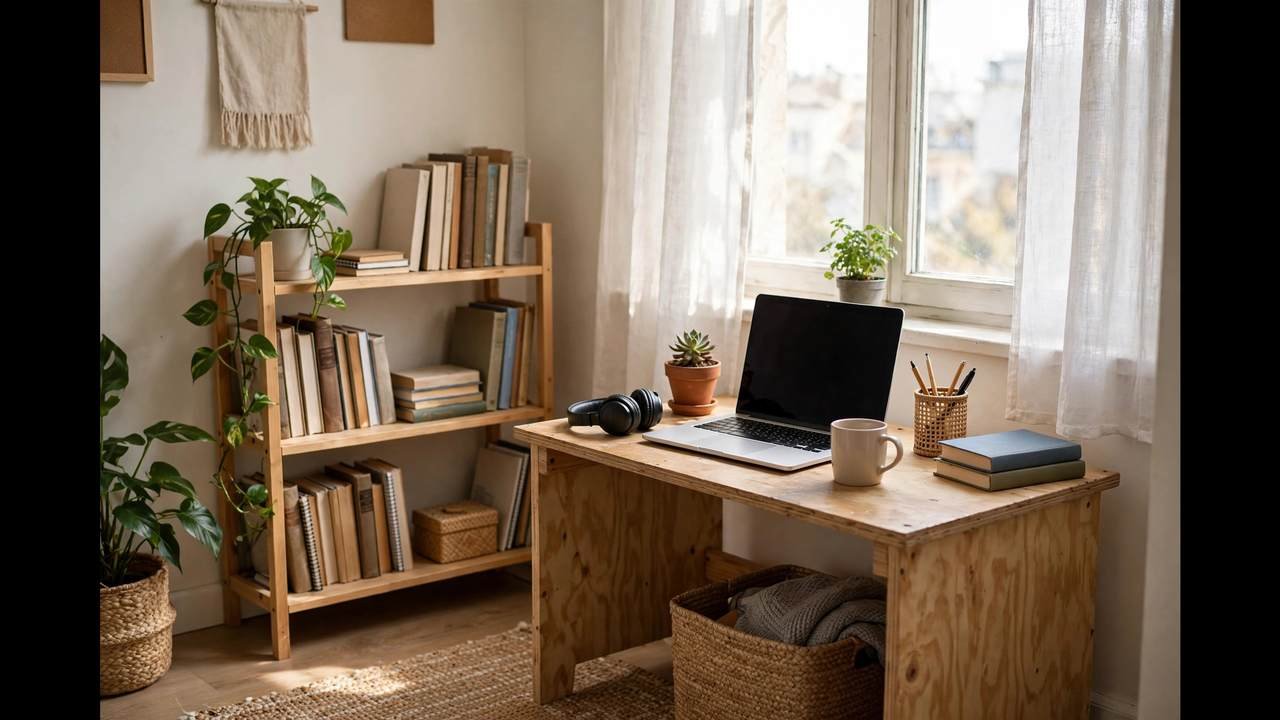
Good home study space ideas in Australia do not require a renovation or a four-figure budget. They require a clear desk, a chair that does not hurt, decent light and a door you can close — physically or psychologically. As an online learner, your study space is your campus: it is where lectures happen, assignments get written and exams are sat. Students who study wherever they happen to land — couch, bed, kitchen bench — consistently report worse focus and longer sessions than students with a dedicated spot, even a tiny one.
This guide shows you how to build an effective study space at three budget levels, with Australian retailers, secondhand strategies and small-space solutions. Every price mentioned is in Australian dollars and grounded in what these items actually cost here in 2026.
Start With What You Have: The $0 Setup
Before spending anything, audit what you already own. Most households contain a viable study space hiding in plain sight: a dining table near a window, a rarely used corner of a bedroom, even a cleared section of a kitchen bench. The $0 setup is about claiming a spot and making it psychologically distinct from the rest of your life.
Three free moves make the biggest difference. First, dedicate the spot: even if it is half the dining table, that half is now your study zone during study hours. Your brain learns context cues quickly — sitting in the same spot repeatedly trains it to switch into focus mode on arrival. Second, declutter ruthlessly: remove everything from the study surface that is not needed for the current session. Visual clutter competes for attention; a clear desk is not aesthetic advice, it is cognitive advice. Third, control the boundary: if you cannot close a door, create a ritual that marks study time — headphones on, a specific playlist, a “studying” sign for housemates. Rituals substitute for walls surprisingly well.
Studying on your bed deserves a special warning: it trains your brain to associate the bed with alert cognitive work, which is a reliable recipe for worse sleep. If your bedroom is your only option, study at a desk or table in the room — never propped on the pillows. Your sleep will thank you, and sleep is a study tool.
The Desk: Your Biggest Decision
The desk is the foundation, and the good news is that functional desks are cheap in Australia. Your minimum viable desk needs a surface roughly 100–120 cm wide and 50–60 cm deep — enough for a laptop plus a notebook, or a monitor plus keyboard. Anything smaller forces constant shuffling, which breaks flow.
At the budget end, flat-pack desks from Kmart, IKEA and Target start at genuinely low prices, and the secondhand market is flooded with solid options — desks are bulky, so sellers on Facebook Marketplace and Gumtree often list them cheaply just to clear space. A quick search in any Australian capital city turns up sturdy secondhand desks for a fraction of retail; bring a friend and a car, because delivery is where secondhand deals die.
One step up, height-adjustable desks have become remarkably affordable. Kmart’s marketplace, for example, lists electric standing desks around the $129–144 AUD mark (such as this motorised standing desk on kmart.com.au), which would have been unthinkable a few years ago. Alternating sitting and standing during long study days genuinely helps with afternoon energy slumps — you do not need it on day one, but it is a worthy upgrade once your basic setup works.
Whatever desk you choose, prioritise stability and size over features. A wobbly desk ruins handwriting and typing; a desk with built-in charging ports but a tiny surface is a worse study tool than a big plain table. And measure your space before buying — Australian bedrooms and rental apartments punish optimistic furniture purchases.
The Chair: Do Not Skimp Here
If your budget forces one splurge, make it the chair. You will spend hundreds of hours in it, and a bad chair produces back pain, neck strain and the kind of low-grade discomfort that silently shortens every study session. Dining chairs and stools are fine for an hour; they are miserable for a full study day.
What to look for: adjustable seat height (your feet flat on the floor, knees roughly at right angles), lumbar support for your lower back, and a backrest you can lean into. You do not need a $1,000 ergonomic flagship — but you do need those three things. The secondhand market is your friend here too: quality office chairs from office liquidations and marketplace listings sell for a fraction of their new price, and a five-year-old premium chair usually outperforms a brand-new cheap one. When buying secondhand, test the gas lift (does it hold height?), the tilt mechanism and the armrests before paying.
If a proper office chair is genuinely out of reach right now, improve what you have: a lumbar cushion (or a rolled towel) tied to a dining chair transforms it, and a footrest — even a sturdy box — fixes the dangling-feet problem that causes lower-back ache. Small ergonomic fixes compound over long sessions.
Light It Right (Mostly Free)
Lighting is the most underrated element of a study space, and the best source is free: daylight. Position your desk near a window if at all possible, ideally with the window to your side rather than directly in front (glare on screens) or behind you (you become a silhouette on webcam calls and exams). Natural light regulates your alertness and mood far better than any bulb.
For evenings — and Australian winter afternoons get dark early in the southern states — you need a task lamp. The rules: light the work surface, not your eyes; choose a lamp with adjustable brightness and a neutral-to-cool colour temperature for focus work; and position it opposite your writing hand to avoid shadows across your notes. Basic LED desk lamps are inexpensive at Kmart, IKEA and Officeworks, and they sip electricity. Avoid studying under a single harsh overhead light, which creates screen glare and eye strain; a lamp plus soft background lighting is the comfortable combination.
If you sit supervised online exams, check your lighting on camera in advance: you need to be clearly visible, not backlit. A cheap lamp positioned behind your monitor, aimed at your face, solves most webcam lighting problems.
Taming Noise and Distractions
Australian share houses, apartments with thin walls and family homes all produce the same enemy: unpredictable noise. Total silence is not required — consistent, controllable sound is. Here is the hierarchy, from free to cheap:
- Negotiate quiet hours. Tell housemates or family your exam and deep-study times. A shared calendar or a note on the fridge prevents most conflicts; people are usually accommodating when they know the schedule in advance.
- Use sound to mask sound. Consistent background audio — brown noise, rain sounds, or instrumental music — masks intermittent noise far better than silence does. Free options abound on YouTube and Spotify.
- Get decent headphones. You do not need premium noise-cancelling, though it is lovely; even basic over-ear headphones with background audio create a convincing cone of focus. If you already own earbuds, start there.
- Face the wall, not the room. Position your desk so your visual field contains as little movement as possible. Facing a window with a view of the street is lovely and terrible for concentration in equal measure.
- Phone discipline. The phone is the distraction that defeats every study space. During study blocks, put it in another room — not face-down beside you, another room. The research on this is unambiguous: mere proximity of a phone reduces available cognitive capacity.
The Tech Setup: Ergonomics for Your Devices
You do not need much technology beyond your laptop, but two cheap additions pay for themselves in comfort. First, raise your screen to eye level: a laptop flat on a desk forces your neck into a permanent downward bend. A laptop stand — or a stack of sturdy books, the classic budget solution — plus an external keyboard and mouse transforms the ergonomics completely. This matters enormously if you study for hours daily; neck and shoulder pain is one of the most common complaints among online learners.
Second, sort your cables: a power board with a long cord, positioned where your charger reaches without stretching across the desk. Exam-day cable hunts are a stress you can permanently eliminate for the price of a power board. Keep a backup of critical access — your university login, MFA method and unit coordinator contacts — somewhere accessible even if your laptop dies. And if your home internet is unreliable, know your fallback before you need it: a phone hotspot, or the nearest library or campus with eduroam Wi-Fi.
Small Spaces: Study Nooks That Actually Work
Many Australian students study in bedrooms, studios or shared houses where a dedicated study room is fantasy. Small-space solutions that work:
- The wardrobe desk: a fold-down wall-mounted desk inside or in front of a wardrobe creates a study space that literally disappears after hours — excellent for separating study from rest in a studio.
- The corner claim: a small 80 cm desk tucked into a bedroom corner, facing the wall, with a bookshelf or curtain as a visual divider. Facing the wall minimises distraction and the divider marks the boundary.
- The mobile station: a laptop, a lap desk and your headphones in a dedicated bag. When the house is too chaotic, relocate to a library, café or park. Some of the best study sessions happen away from home — the key is having a portable kit ready so relocation takes minutes.
- Vertical storage: in small rooms, go up — wall shelves, pegboards and over-desk organisers keep supplies accessible without consuming floor or desk space.
The principle across all of these: separation beats size. A tiny nook that is unambiguously “for study” outperforms a large multi-purpose table for focus, because your brain binds the context to the behaviour.
Ergonomics on a Budget: The Five-Minute Desk Assessment
You do not need an ergonomics consultant — you need five minutes and a mirror (or your phone’s selfie camera). Sit at your study setup as you normally would and check: feet flat on the floor (if they dangle, you need a footrest or a lower chair); knees at roughly right angles; back supported by the chair’s backrest with a small gap filled at the lumbar curve; screen top at or slightly below eye level, about an arm’s length away; shoulders relaxed, not hunched toward your ears; wrists straight while typing, not bent upward.
Every failure on that checklist has a budget fix: dangling feet → a sturdy box or a cheap footrest; no lumbar support → a rolled towel; screen too low → books or a basic laptop stand; hunched shoulders → raise the chair or lower the desk so your arms rest naturally. None of these cost more than a few dollars, and together they determine whether a three-hour study session leaves you fresh or aching. Re-run the assessment whenever you change anything about your setup — ergonomics is a system, and one change (like a new chair) can unbalance the rest.
Sample Budgets: What This Costs in Practice
Here is how the pieces add up at three levels, using realistic Australian options:
- The $0–50 setup: existing table claimed as a study zone, books as a laptop stand, daylight plus an existing lamp, earbuds you own, phone-in-another-room discipline. Total cost: nothing but intention. This handles a full semester perfectly well.
- The ~$150–250 setup: secondhand desk and office chair from Marketplace or Gumtree, a basic LED desk lamp from Kmart or IKEA, a laptop stand and external keyboard/mouse combo. This is the sweet spot — genuine ergonomic comfort for the price of a textbook or two.
- The ~$400–600 setup: everything above, plus a height-adjustable desk (electric models on Kmart’s marketplace start around $129–144 AUD), a quality secondhand ergonomic chair, decent headphones and proper cable management. A setup that rivals a corporate home office, built patiently over time.
Build in stages. Start with the free setup, add the chair when you can, then the desk, then the nice-to-haves. Each upgrade should solve a specific discomfort you have actually felt — not an imagined ideal. And remember that the space serves the study system: pair your new setup with solid time management for your study blocks, and protect the boundary between study space and rest space — blurring that line is a fast track to online learning burnout.