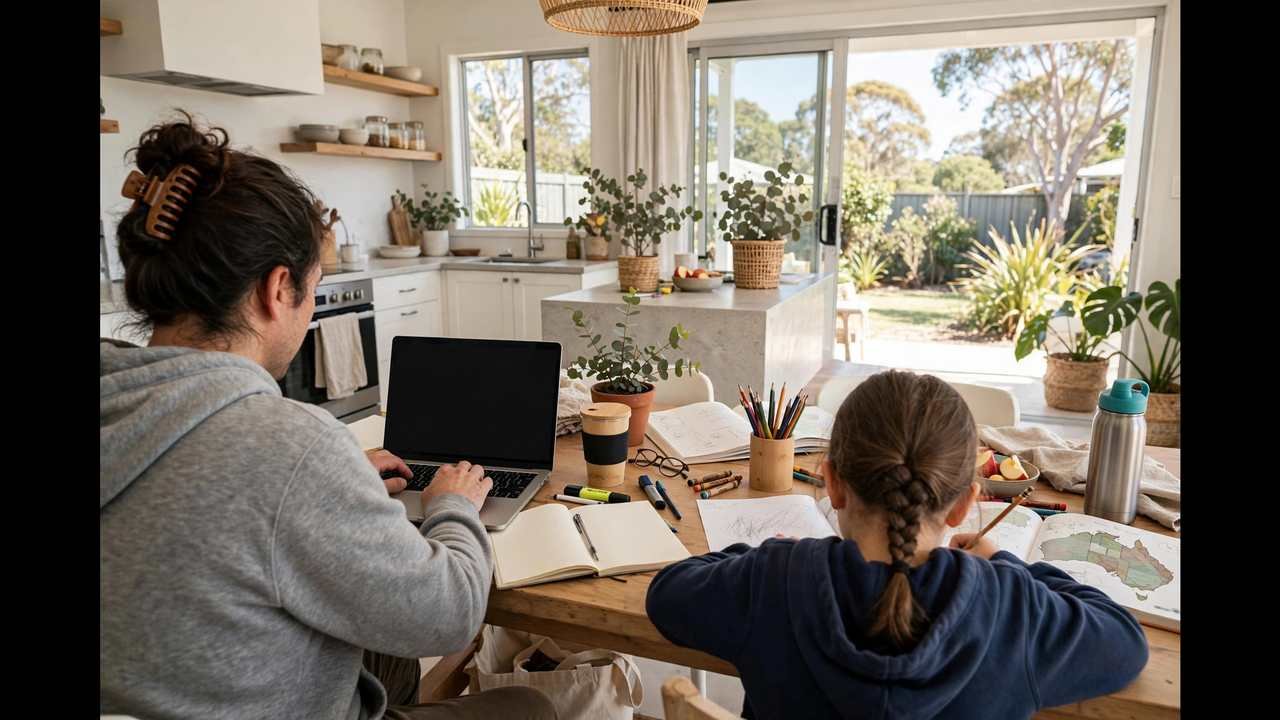
Homeschooling online australia parent guide? More Australian families are choosing home education than ever before — and the internet has transformed what it looks like. Modern homeschooling in Australia isn’t a parent single-handedly recreating school at the kitchen table; it’s a hybrid of online programs, community co-ops, tutors, and parent-led learning, all operating within a clear (if state-variable) legal framework. This complete parent guide covers registration in every state, real costs, curriculum approaches, the best online resources, socialisation, and how homeschooled students get into university.
Is homeschooling legal in Australia? Yes — with registration
Home education is legal in every Australian state and territory, but all eight jurisdictions require formal registration. You can’t simply stop sending your child to school; you must register with your state’s authority and demonstrate that you’re providing a proper education. The compulsory ages are generally 6 to 16 or 17 (Queensland: 6–16 or until Year 10; NSW and Victoria: 6–17).
The registration systems differ meaningfully by state:
- NSW: register through the NSW Department of Education’s Home Schooling Unit, submitting an educational program that an authorised person assesses. NSW uses its own syllabuses (not the Australian Curriculum), taught at the stage you choose for each subject. Home visits can be requested but aren’t automatic. In 2025, only 0.61% of applications were refused for not meeting requirements.
- Victoria: register with the VRQA (Victorian Registration and Qualifications Authority), submitting a learning plan covering eight key learning areas. The VRQA must decide within 28 days of receiving a complete application, and selects up to 10% of registrations for review each year. Victoria refused no applications in 2024–25.
- Queensland: register with the Home Education Unit (HEU). If your child is currently in school, notify the school of your intent — you’re covered by provisional registration while the application is processed, so there’s no truancy gap. Queensland doesn’t mandate a specific curriculum.
- South Australia: the Department for Education manages registration; your program should align with the Australian Curriculum (or similar) and include progress-monitoring strategies, resources, a suitable environment and social opportunities.
- Western Australia: register with your local education office, demonstrating how you’ll meet curriculum requirements (the WA Curriculum can be referenced but isn’t mandatory).
- Tasmania: the Office of the Education Registrar handles registration with ongoing reviews.
- ACT & NT: register through the territory education departments; the ACT encourages (but doesn’t require) the Australian Curriculum.
Practical advice: start the registration process before you need it — approval can take up to twelve weeks in some states. And keep records from day one: work samples, reading logs, resource lists. A simple binder per child per year, organised by learning area, satisfies every state’s review requirements. Detailed, regulator-linked guidance on learning plans is available at HomeschoolAU’s registration resources.
What does homeschooling actually cost?
Costs vary enormously by approach, but a realistic range is $1,500–$2,400 per child per year for a well-resourced home education:
- Curriculum/programs: $0 (free resources + library) to $1,000+ for all-in-one paid curricula
- Online subscriptions: $100–$300/year (Reading Eggs, Mathletics, etc.)
- Materials: $200–$500/year (art supplies, science kits, printing, books)
- Activities: $300–$800/year (sport, music, co-op fees, excursions)
- Distance education providers: higher — some charge per subject
Natural learning / unschooling approaches can cost very little; structured all-in-one programs cost the most. The hidden cost is parental time — one parent typically reduces work hours, which dwarfs every other expense. Budget honestly for this.
Curriculum approaches: picking your philosophy
Structured / school-at-home: following a set curriculum (Australian Curriculum-aligned programs, purchased packages) on a timetable. Suits parents who want clarity and children who thrive on routine. Easiest for registration paperwork.
Eclectic: mixing resources — an online maths program, library books for English, co-op science classes. The most common approach among experienced homeschoolers: take the best tool for each subject.
Charlotte Mason / classical: literature-rich, narration-based approaches with strong parent communities in Australia. Beautiful but parent-intensive.
Unschooling / natural learning: child-led learning through life, interests and projects. Legally fine in most states (you still register and demonstrate learning), but requires confident record-keeping to satisfy reviews.
Distance education: enrolling with a registered distance education school (available in every state, originally designed for remote families). More structured and school-like; useful for families wanting external accountability.
There’s no universally “best” approach — only the best fit for your child, your capacity and your state’s requirements. Most families evolve: structured in the early years, more eclectic as everyone finds their feet.
Homeschooling online in Australia: the toolkit families actually use
Online resources are the backbone of most Australian homeschooling. The core stack:
- Literacy & numeracy: Reading Eggs, Mathletics, Matific — see our learning platforms guide for the full comparison.
- All-subject backbone: ABC Education (free, Australian Curriculum-aligned) covers enormous ground.
- Maths extension: Khan Academy, Eddie Woo’s Wootube — free and excellent through senior years.
- Writing: structured writing programs (various Australian providers) or the free resources from state English teacher associations.
- Science: co-op classes and kits for hands-on work; online videos and virtual labs for theory.
- Record-keeping: simple digital portfolios (photos of work, dated samples) make annual reviews painless.
Our free educational websites guide lists dozens more no-cost resources, and the educational apps roundup covers tablet-friendly options.
Socialisation: the question everyone asks
Let’s address it directly: the research and the lived experience both say homeschooled children socialise differently, not less. Typical Australian homeschool social life includes:
- Homeschool co-ops: weekly group learning days — the social and academic heart of most homeschool communities. Every capital city and most regional centres have active co-ops.
- Sport, dance, art, music: the same extracurriculars schooled kids do, often with more scheduling flexibility.
- Library and museum programs: most run dedicated homeschool sessions.
- Volunteering and community projects: easier to fit in without school hours constraining the week.
- Part-time work (teens): many homeschooled teens work part-time, building workplace social skills early.
The honest nuance: socialisation requires parental effort in a way school doesn’t. If you’re considering homeschooling, budget time for co-ops and activities with the same seriousness as curriculum — the families who struggle socially are usually the ones who underestimated this, not the ones whose children lack opportunities.
A day in the life: what it really looks like
Forget the 9-to-3 replica. A typical primary homeschool day runs 2–3 focused hours:
- Morning (9:00–11:30): core skills — maths and English, the non-negotiables, when focus is best.
- Midday: lunch, outdoor play, free time. Many families protect this fiercely — it’s where childhood happens.
- Afternoon (1–2 days/week): co-op, sport, or project work. Other afternoons: reading, hobbies, life.
Secondary years add more structure (4–5 hours), especially approaching senior credentials. The efficiency is real: without classroom management overhead, transitions and assemblies, homeschoolers routinely cover the core curriculum in far fewer hours — leaving time for depth, interests and rest.
Senior years and university pathways
The question that worries parents most has the clearest answer: yes, homeschooled students get into Australian universities — through well-established pathways:
- HSC/VCE as an external candidate: the most common route — sit the state senior certificate independently and earn an ATAR like any other student.
- TAFE-to-university articulation: complete a TAFE diploma, then enter university with credit — a pathway many homeschoolers prefer for its practicality.
- Alternative entry: STAT tests, portfolios, and discretionary entry schemes that universities run for non-traditional applicants.
- International credentials: Cambridge International A-Levels or the IB through registered providers.
Universities including Sydney, UNSW, Macquarie, UTS, Western Sydney, Wollongong and Newcastle all admit homeschool students through these pathways. Plan backwards from age 15: whichever pathway you choose needs 1–2 years of preparation, so decide by Year 10.
Withdrawing from school: managing the transition
The logistics matter as much as the philosophy. If your child is currently enrolled:
- Notify the school in writing of your intent to home educate, keeping a copy. In Queensland, your HEU application gives you provisional registration — keep records so your child isn’t marked truant during processing.
- Request school records: reports, NAPLAN results, any assessments. They’re useful baselines for your own planning and may be needed for registration evidence.
- Allow a deschooling period: experienced homeschoolers recommend 1–2 weeks (or longer after a difficult school experience) of no formal learning — rest, play, read for fun. Jumping straight into a rigid timetable often backfires; everyone needs to decompress and reset their relationship with learning.
- Start lighter than you think: begin with core skills (maths, English) plus lots of free time, then add subjects as the routine beds down. You can always add; subtracting a failed overloaded schedule is harder.
- Talk to your child honestly: explain what’s changing and what isn’t, involve them in choosing resources, and give the new arrangement a named trial period (“let’s try this for one term, then review together”).
Homeschooling children with additional needs
A significant proportion of Australian homeschoolers have ADHD, autism, dyslexia, anxiety or other additional needs — often because school environments weren’t working for them. Homeschooling can be transformative here: no sensory-overwhelming classrooms, pacing matched to the child, learning built around strengths.
- NDIS and homeschooling are separate tracks: home education registration doesn’t affect NDIS eligibility or funding — they’re entirely different administrative systems.
- Therapies continue: schedule speech, OT or psychology around your flexible timetable — one of homeschooling’s genuine advantages.
- Document differently: progress for a child with additional needs may not look like year-level advancement. Record growth against the child’s own baseline — regulators accept this when it’s clearly documented.
- Find your community: additional-needs homeschool networks exist in every state and are among the most supportive parent communities in the country. Don’t do this isolated.
Our guides to helping kids with ADHD learn online and keeping kids safe online complement this section.
Common mistakes new homeschoolers make
- Recreating school at home: 6-hour days, bells, uniforms — the fastest path to everyone hating it. Homeschooling’s efficiency is the point; use it.
- Buying the full curriculum package on day one: expensive all-in-ones often gather dust. Start with free/low-cost resources, discover how your child learns, then invest selectively.
- No record-keeping: “we’ll remember” doesn’t survive an annual review. Ten minutes a week photographing work and jotting notes saves a panic later.
- Isolating: skipping co-ops and groups in the busy early months, then wondering why everyone’s lonely by term two. Social infrastructure takes time to build — start immediately.
- Comparing constantly: to schooled peers, to other homeschoolers, to curriculum timelines. Your child’s trajectory is the only one that matters.
- Never reviewing: set a termly family review — what’s working, what isn’t, what changes. Homeschooling’s superpower is adaptability; use it.
Finding your people: Australian homeschool communities
You don’t have to figure this out alone — and you shouldn’t. Australia’s homeschool community is large, organised and welcoming:
- State home education associations run events, co-ops, camps and advocacy in every state — join your state’s for registration guidance and community.
- Local co-ops and groups: search “[your suburb/region] homeschool group” — most areas have active weekly meetups.
- Online communities: Australian homeschool Facebook groups (some with tens of thousands of members) are invaluable for curriculum advice, secondhand resources and “is this normal?” reassurance at 11pm.
- Teen networks: as kids grow, teen-specific groups, classes and social events matter enormously — prioritise finding these before your child needs them.
Is homeschooling right for your family? An honest checklist
- Can one parent realistically dedicate 15–20 hours a week (primary) or oversee 25+ (secondary)?
- Is your child self-motivated enough for independent work, or will every session be a battle?
- Are you prepared to be the record-keeper, the scheduler and the advocate — not just the teacher?
- Does your state’s registration feel manageable (compare the requirements above)?
- Have you connected with local homeschoolers to see the reality, not the Instagram version?
- What’s your exit plan if it doesn’t work? (Re-enrolling in school is always an option — it’s not failure.)
Homeschooling thrives on parental commitment more than parental qualifications — you don’t need a teaching degree, you need organisation, patience and a willingness to learn alongside your child. Families who go in clear-eyed about the workload love it; families who expect an easier version of school are disappointed. For day-to-day tactics once you’re underway, our guide to supporting your child’s online learning at home applies directly.