Whether your child is learning fully from home, doing homework after school, or catching up on weekends, one thing makes more difference than any app or tutor: a consistent learning routine. Kids thrive on predictability. When learning happens at the same time, in the same place, in roughly the same order each day, it stops being a negotiation and starts being just what happens. Building a learning routine kids home life can sustain isn’t about replicating school minute-by-minute — it’s about creating a rhythm your family can actually sustain.
This guide walks you through designing a home learning routine step by step: finding your child’s best learning window, structuring the day into manageable blocks, setting up the right space, and keeping the whole thing going when motivation dips — as it will.
Learning Routine Kids Home: Why It Matters So Much
Children — especially younger ones or those who are anxious — feel calmer when they know what’s coming next. A predictable routine reduces the mental load of constant decision-making (“what now?”) for both you and your child, and it protects learning time from being squeezed out by the day’s chaos.
There’s a practical payoff too. Learning compounds: twenty focused minutes of reading every day builds far more skill than a heroic two-hour session once a fortnight. A routine is simply the delivery system for that consistency. Families who’ve been through school refusal often discover this firsthand — a gentle, predictable home routine can rebuild a child’s confidence in learning when the school environment has become overwhelming.
And here’s the part busy parents need to hear: the routine doesn’t need to be elaborate. In fact, the simpler it is, the more likely it survives contact with real life — sick days, late meetings, and all. A simple routine written on a single sticky note that you actually follow will outperform a colour-coded spreadsheet that collapses by Wednesday.
Routine vs Schedule: Choose the Right Approach
Before you plan anything, decide whether your family needs a routine or a schedule. A schedule assigns clock times to everything (9:00 maths, 9:45 break). A routine follows an order of events without fixed times (breakfast, then reading, then a break, then maths).
For most families, a routine beats a schedule. Clock times create stress when life intervenes — and life always intervenes. An ordered routine flexes: if breakfast runs late, everything simply shifts. Young children especially respond better to sequence (“after lunch we do our project”) than to abstract times.
That said, older students with multiple subjects, assignment deadlines and online class times often need scheduled blocks to stay on track. A good compromise: routine-style mornings for core learning, with scheduled anchors for fixed commitments like live online lessons or tutoring sessions.
Step 1: Find Your Child’s Learning Window
Every child has a window of peak focus — a time of day when their brain is most ready to absorb new ideas and wrestle with hard problems. For many children it’s mid-morning, after they’ve woken up properly and had some movement. For some teenagers, it’s not until after lunch. Night owls forced into 8am algebra will struggle no matter how good the routine looks on paper.
Watch your child for a few days before you plan. When are they most alert and cooperative? When do they fade? Once you’ve spotted the window, protect it fiercely: put the hardest, most important learning there — new maths concepts, writing, focused reading. Save lighter, independent work (educational videos, revision, creative projects) for lower-energy times. If your child takes medication that affects focus, such as for ADHD, align the hardest block with when it’s most effective — your paediatrician or GP can advise on timing.
Also work around your family’s non-negotiables first: work calls, school drop-offs, sport training, therapy appointments. These are the anchors — build the learning routine around them, not the other way around. A routine that ignores reality lasts about three days.
Step 2: Build the Day in Blocks, Not Subjects
Rather than timetabling every subject, organise the day into two or three blocks. This keeps planning simple and absorbs disruptions gracefully:
- Morning block — core learning with you. Reading, writing and maths — the subjects that benefit most from your direct involvement. For primary kids, 60–90 minutes total is plenty.
- Middle block — independent work or projects. Worksheets, online programs, science observations, art, or practising an instrument. Your child works more autonomously while you get things done nearby.
- Afternoon block — lighter learning. Reading for pleasure, educational shows, outdoor exploration, cooking (maths in disguise), or life skills.
Between blocks, build in genuine breaks — and make them active. Young children can concentrate for roughly 15 minutes at a time before needing to move; even older kids need regular stretch breaks. A 10–20 minute burst of physical activity between learning blocks resets attention far better than scrolling a phone. The Raising Children Network’s guide to homework routines makes the same point: minimise distractions during work time, then let kids move and play freely when it’s break time.
Sample Learning Routines by Age
Use these as starting templates, then adjust to your child’s window and your family’s anchors.
Ages 5–8: Short, playful, visual
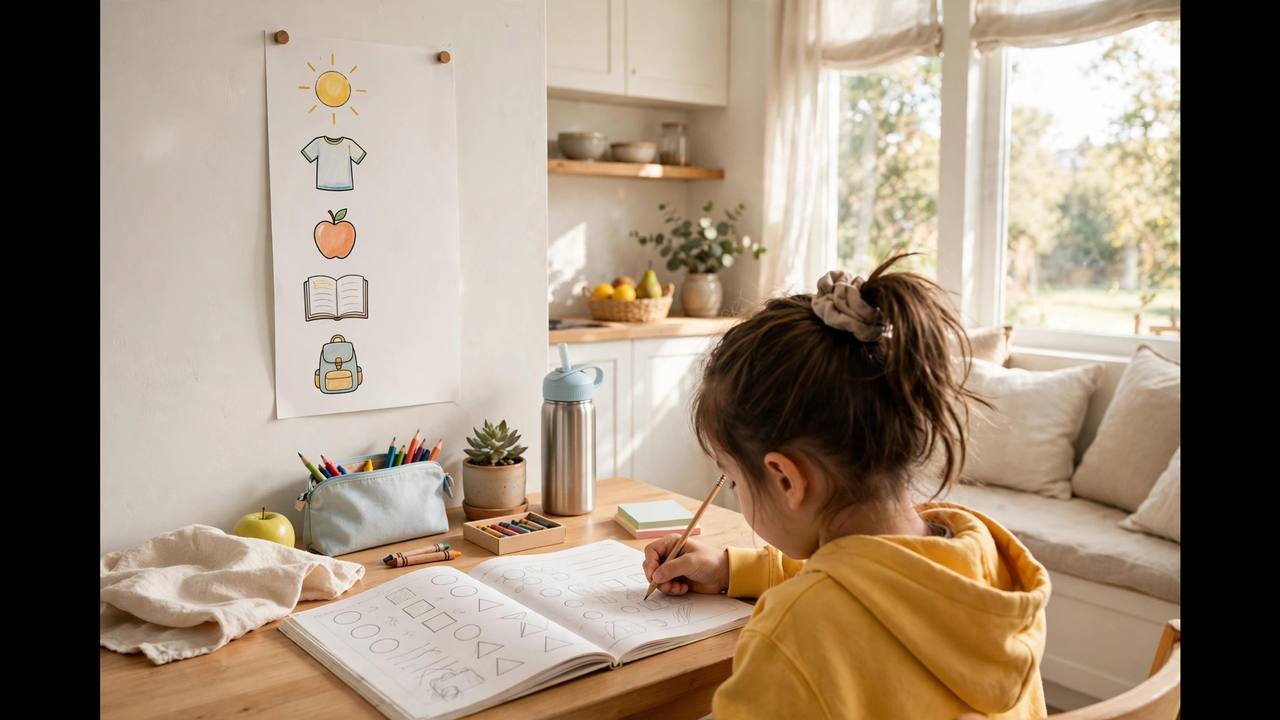
Young children need structure they can see. A picture schedule on the fridge — with images for each step — works better than any written timetable. Aim for about 1–2 hours of total learning, broken into 15–20 minute bursts:
- Morning: 20 minutes reading together (take turns with pages), movement break, 15 minutes of number games or worksheets, snack break
- Midday: creative project or science observation (30 minutes), outdoor play
- Afternoon: 15 minutes on a reading program or educational app, then free reading or audiobooks
Keep it playful and end with something they enjoy. At this age, protecting the love of learning matters more than covering content.
Ages 9–12: Building independence
Preteens can handle longer blocks and benefit from having some say. Let them help order the subjects or choose between task options — ownership boosts compliance enormously. Aim for 2–3 hours of focused learning:
- Morning block (90 min): maths and writing, with a movement break halfway
- Middle block (60 min): independent work — online lessons, project research, practising times tables or spelling
- Afternoon (45 min): reading for pleasure, plus a creative or physical activity of their choice
Introduce a simple planner or checklist they tick off themselves. The visual progress is motivating, and it teaches the executive-function skills they’ll need in secondary school.
Teenagers: Structured autonomy
Teens need routines that respect their growing independence while keeping accountability visible. Co-design the week together: fixed study blocks, but they choose the order. Use a shared calendar for deadlines and exam dates. Three to four hours of focused study on school days is a reasonable target for most, broken into 45–50 minute sessions with real breaks.
Connect the routine to their goals — ATAR ambitions, a course they want, a skill they’re building — rather than to your authority. “This gets you closer to X” sustains motivation far longer than “because I said so.” And protect sleep ruthlessly: a tired teenager’s 6am study session is mostly theatre.
Setting Up the Right Learning Space
Where learning happens shapes how well it happens. You don’t need a dedicated study — you need a consistent spot with the right conditions:
- Same place, every day. Consistency cues the brain that it’s learning time. The kitchen table is ideal for younger kids (you’re nearby to help); older kids usually do better in a quieter spot of their own.
- Light and air. Natural light where possible, enough space to spread out books and materials.
- Distraction audit. TV off, toys out of sightline, phones in another room during focus blocks. For device-based learning, turn off notifications.
- Ergonomics matter. Screens at eye level and at a comfortable distance reduce neck and eye strain — especially important as screen hours add up.
- A visible routine chart. The day’s order of events where everyone can see it. For young kids, pictures; for older kids, a whiteboard checklist.
One more tip: keep learning materials in one place — a box, shelf or caddy per child. Ten minutes hunting for the maths book every morning will quietly kill any routine.
Learning Routine Kids Home: Keeping It Going When Motivation Dips
Every routine hits rough patches. Motivation is cyclical, especially for kids. These strategies keep things moving through the dips:
- Start tiny on hard days. “Just do the first ten minutes” almost always turns into more — and even when it doesn’t, ten minutes keeps the habit alive.
- Praise effort and persistence, not just results. “You stuck with that tricky maths for twenty minutes” builds the identity of someone who persists.
- Build in choice. “Do you want to do reading before or after your break?” gives control without derailing the plan.
- Use a weekly theme rhythm. Instead of everything every day, rotate: Monday reading focus, Tuesday maths games, Wednesday writing, Thursday science curiosity, Friday review and fun. Variety fights boredom.
- Review together weekly. A quick Sunday chat — what worked, what felt too hard, what should change — keeps the routine evolving instead of calcifying. Kids who help design the routine defend it.
- Protect the anchor habit. If the full routine collapses on a chaotic day, keep one non-negotiable (usually reading). The routine survives as long as its core survives.
Learning Routines for Tricky Situations
Real families have complications. Here’s how to adapt the routine without abandoning it:
- Multiple kids, different ages. Run a shared rhythm with split attention: while you do focused work with one child, the other does independent practice, then swap. Stagger the hard blocks so you’re never needed in two places at once. Older siblings can read to younger ones — it counts as learning for both.
- Shift work or unpredictable hours. Anchor the routine to events, not times: “after breakfast” works whether breakfast is at 7am or 10am. Prepare grab-and-go learning baskets the night before so whichever parent is on duty can just hand them over.
- School holidays. Drop to a “holiday minimum”: twenty minutes of reading and a little maths a day. That’s enough to prevent the holiday slide without anyone feeling like school never ended.
- Working from home alongside them. Sync your deep-work blocks with their independent-work blocks. Parallel focus time — everyone working quietly in the same room — can be surprisingly harmonious, and it models exactly the concentration you’re asking of them.
The principle is always the same: shrink the routine before you skip it. A tiny routine you keep beats a perfect routine you abandon.
When the Routine Falls Apart (It Will)
Here’s the secret nobody puts on the fridge chart: every family’s routine falls apart regularly. Illness, holidays, busy work weeks, bad moods — something will always interrupt. The families who succeed aren’t the ones whose routine never breaks; they’re the ones who restart without guilt.
When you miss a day (or a week), don’t try to “catch up” by doubling the next day’s load. Just start again with today’s plan. Cramming the missed work in creates exactly the overwhelmed feeling that makes kids resist the routine in the first place.
And if the routine consistently isn’t working after a few weeks of honest effort, that’s data, not failure. Maybe the learning window is wrong, the blocks are too long, or your child has outgrown the structure. Adjust one thing at a time and observe. A learning routine is a living system — it should grow with your child, not constrain them.
Start this week: pick one anchor (after breakfast, after school pickup, whenever), attach twenty minutes of reading to it, and do that — and only that — for two weeks. Once it’s automatic, add the next block. Small, steady and sustainable beats ambitious and abandoned, every single time. And remember: the goal was never a perfect timetable. It’s a child who knows that learning is simply part of how their day works.