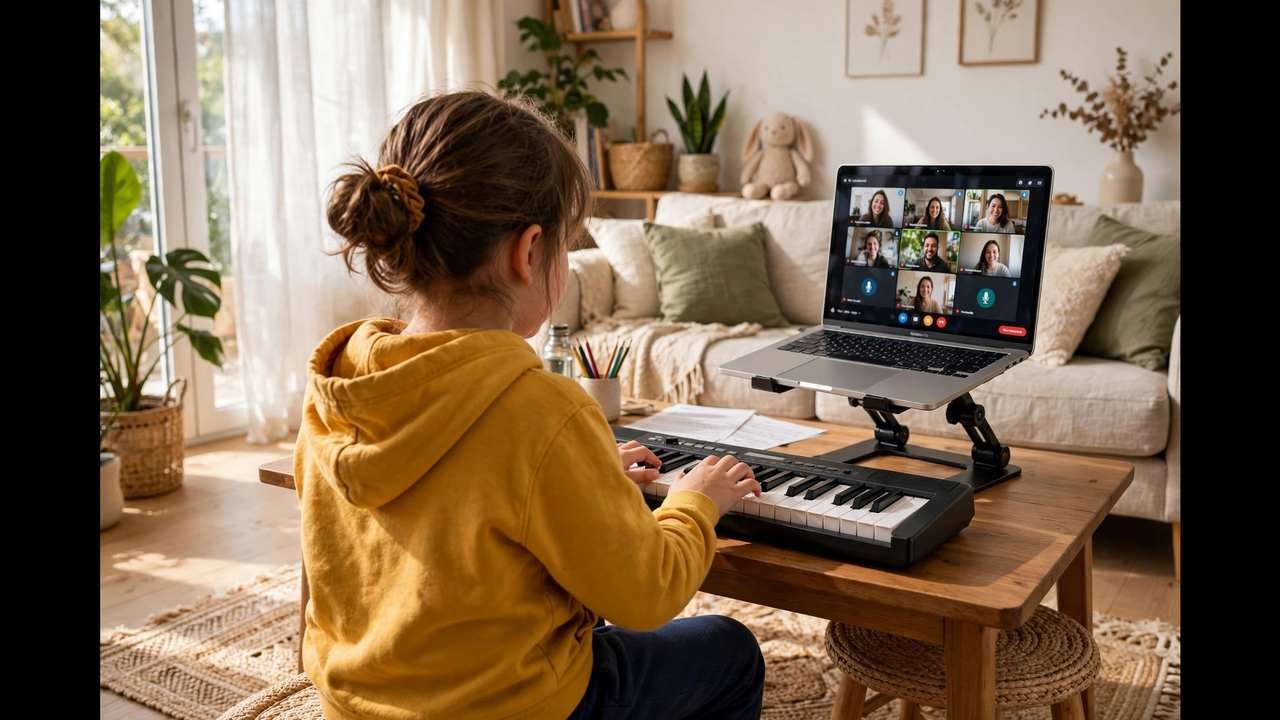
Music lessons went online and never fully went back — and for many families, that’s good news. Online music lessons remove the commute, widen the choice of teachers beyond your suburb, and often cost less than studio lessons. This guide covers the best online music lesson options for Australian kids: live 1-on-1 teachers, platforms and apps, real AUD pricing, and how to set your child up to actually stick with it.
Can kids really learn music online?
The honest answer: yes, with caveats. Online lessons work best for:
- Beginners through intermediate: fundamentals — reading music, technique basics, rhythm — teach perfectly well over video.
- Self-motivated kids: without a teacher physically present, the child needs enough internal drive to practise between lessons. (Parents supply the external drive — see below.)
- The right instrument: piano/keyboard, guitar, ukulele, violin and voice all work well online. Drums work but need volume management; some wind instruments need in-person embouchure correction early on.
Where online struggles: advanced technique refinement (a teacher can’t physically adjust hand position), ensemble playing (latency kills real-time jamming), and very young beginners who need hands-on guidance. For most kids aged 6–14 learning their first instrument, online is genuinely effective.
Option 1: Live 1-on-1 online teachers
The closest to traditional lessons — a real teacher, weekly video sessions, personalised feedback. Australian providers include dedicated online music schools and independent teachers:
- How it works: weekly 30-minute video lessons (the standard for under-13s), teacher assigns practice, progress reviewed each week. Platforms like Zoom or dedicated lesson rooms.
- Pricing: expect roughly $49–$75 per 30-minute lesson depending on provider and teacher experience. Examples from current Australian pricing: Ignite Music lists 30-minute weekly private lessons at $49; The SoundLab’s 10-week 30-minute course works out to $65/lesson; Stormer Music’s online lessons are $59+GST per lesson. Term programs (e.g. $600/term for school-aged 30-min lessons) often beat casual rates.
- What to look for: Working With Children Check, music qualifications or demonstrable teaching experience, a structured curriculum (not just “playing songs”), and a trial lesson.
- Best for: kids who need accountability and personal feedback; families wanting the traditional lesson structure without the drive.
Stormer Music’s online lessons program is a good example of the format: personalised instruction across guitar, piano, singing, violin and drums via video lesson rooms.
Option 2: Music lesson platforms and marketplaces
- Tutor marketplaces: platforms connecting you with independent music teachers for online lessons — wider choice, variable quality. Vet carefully: qualifications, reviews, trial lesson.
- Subscription lesson libraries: pre-recorded video courses (piano, guitar, ukulele) with structured progression. Far cheaper ($15–$30/month typical) but no personal feedback — best as a supplement or for self-directed teens.
- App-based learning: apps like Simply Piano, Yousician and Flowkey listen to your playing and give instant feedback. Excellent for getting started and maintaining motivation; limited for technique correction. See our educational apps guide.
Option 3: School and community programs
- School instrumental programs: many Australian schools offer instrumental lessons (sometimes online or hybrid). Often the cheapest option and conveniently scheduled — ask what your school provides before looking elsewhere.
- Community music schools: local community music centres increasingly offer online options alongside in-person.
- AMEB exams online: the Australian Music Examinations Board offers video exams for many instruments and grades — online learners can still get formal qualifications.
Choosing the right instrument
- Piano/keyboard: the best first instrument for most kids — visual layout teaches music theory naturally, both hands develop independence, and a decent keyboard costs far less than other instruments. Start with a weighted 88-key keyboard if possible.
- Ukulele: cheap, portable, gentle on small fingers, quick wins. The ideal “is my child interested in music?” test instrument.
- Guitar: great from around age 7–8 (hand size matters). Start with a 3/4 size classical guitar — nylon strings are kinder than steel.
- Violin: wonderful but demanding — intonation (playing in tune) is hard without constant feedback, making teacher choice critical. Consider whether online-only suits your child for this one.
- Voice/singing: teaches beautifully online; no instrument purchase needed. Great confidence builder.
- Drums: electronic kits with headphones solve the neighbour problem and work fine for online lessons.
Let the child choose from a shortlist you’ve vetted for practicality. A child who chose their instrument practises; a child who was assigned one resists.
What age to start?
- Ages 4–5: group music classes (rhythm, singing, movement) rather than instrument lessons. Programs like “Little Musicians” group classes build foundations joyfully.
- Ages 6–7: the sweet spot for starting piano, ukulele or violin — fine motor skills ready, attention span sufficient for 30-minute lessons.
- Ages 8+: any instrument; guitar and drums become practical as hands grow.
- Teens: never too late. Self-directed teens often progress fastest — they chose it themselves.
Setting up for online lesson success
- Camera angles matter: the teacher needs to see hands and posture. A laptop positioned to show the keyboard/fretboard plus the child’s upper body. Test the angle before the first lesson.
- Audio quality: the teacher needs to hear tone accurately. A quiet room matters more than fancy microphones; close unnecessary apps that make notification sounds.
- The instrument, tuned and ready: guitars tuned before the lesson (a clip-on tuner is $15 and essential); keyboards at the right height with a proper bench or chair.
- Practice space: the instrument lives somewhere accessible, not in a case in a cupboard. Friction kills practice — a keyboard on a stand in the living room gets played; one packed away doesn’t.
- Parent nearby (young kids): under-10s usually need a parent present for tech help and focus — at least for the first few months.
- Safety: video lessons mean your child on camera with an adult. Use the safety practices in our online safety guide: know the platform, keep doors open, and ensure the provider vets teachers.
Making practice happen (the real battle)
Lessons are 30 minutes a week; progress happens in the other 10,000 minutes. The practice system:
- Short and daily: 15–20 minutes daily beats 2 hours on Sunday. Attach practice to an existing routine (after breakfast, before dinner).
- Make it visible: practice chart on the fridge, streak tracking, teacher-assigned goals. What gets measured gets done.
- Parent involvement (the right kind): sit nearby, show interest, ask them to play what they learned. Don’t correct technique — that’s the teacher’s job. Your job is warmth and consistency.
- Perform regularly: family concerts, recordings for grandparents, school performances, AMEB exams. Music needs an audience — purpose transforms practice from chore to preparation.
- Normalise plateaus: progress isn’t linear. When motivation dips, talk to the teacher before quitting — often a repertoire change or a short break rekindles interest.
- The 3-month rule: don’t judge in the first month (everything is hard). Commit to a full term before deciding. Most quitters quit just before it gets fun.
Costs: the full picture
- Lessons: $49–$75 per 30-min lesson weekly → roughly $500–$750/term. Term programs and direct-debit memberships usually discount this.
- Instrument: keyboard $300–$800; 3/4 guitar $150–$300; ukulele $50–$100; violin (rent first) $30–$50/month rental; electronic drum kit $400+.
- Accessories: tuner, stand, books, metronome app (free) — budget $100 initially.
- Exams (optional): AMEB exam fees per grade — worth it for motivated kids who thrive on goals.
- Money-saving moves: rent before buying (especially violin/cello), buy secondhand instruments, use free apps (Simply Piano free tier, metronome apps), and check school programs first.
Compare with other learning investments in our platforms guide — music typically costs more than academic programs but delivers different (and well-evidenced) cognitive and emotional benefits.
Online vs in-person: the honest comparison
- Teacher choice: online wins — your child can learn from the best teacher for them anywhere in Australia, not just whoever’s within driving distance.
- Convenience: online wins — no commute, easier scheduling, lessons continue through holidays and illness.
- Cost: online usually wins — lower overheads for teachers, no travel costs for you.
- Technique correction: in-person wins — a teacher who can physically guide hand position catches problems cameras miss. This matters most for violin, piano and wind instruments.
- Ensemble and performance: in-person wins decisively — bands, orchestras and duets need shared physical space.
- Focus: mixed — some kids focus better at home; others need the “going to lessons” ritual to take it seriously.
- The hybrid option: increasingly popular — mostly online with periodic in-person sessions for technique check-ups and performances. Ask providers if they offer this.
Group online lessons
Cheaper than 1-on-1 and socially richer — group online lessons suit certain kids well:
- Beginner group classes: ukulele, guitar and keyboard groups where kids learn together. The peer energy motivates; the lower cost ($20–$40/session typical) de-risks the experiment.
- Best for: social kids, uncertain beginners, families testing the waters.
- Limitations: less individual feedback, pace set by the group, harder to address specific problems. Most kids graduate to 1-on-1 within a year if they’re serious.
- What to check: maximum group size (6–8 is the practical limit online), whether absolute beginners are grouped separately, and the progression path to individual lessons.
Music theory online
The unglamorous foundation that makes everything else easier:
- Integrated vs separate: good instrumental teachers weave theory into lessons. If your child’s teacher doesn’t, a dedicated theory supplement helps — especially before AMEB theory exams.
- Free theory resources: musictheory.net (free interactive lessons and exercises), Teoria, and YouTube theory channels cover grades 1–5 thoroughly at zero cost.
- Apps: Tenuto and similar apps drill note reading, intervals and ear training through gamified exercises.
- When it matters: AMEB practical exams from certain grades require theory prerequisites — check the requirements early so theory doesn’t become a last-minute scramble.
The benefits: why music is worth the effort
Parents often need the “why” to sustain the investment through the difficult middle months:
- Cognitive benefits: the research linking music training to improved executive function, working memory and language processing is among the strongest in education. It’s not magic — it’s thousands of hours of focused, structured practice rewiring the brain.
- Emotional regulation: music gives kids a language for feelings they can’t articulate — and a constructive outlet for big emotions.
- Discipline that transfers: the practice habit — showing up daily for something hard with delayed rewards — is a life skill disguised as a hobby.
- Confidence: performing, even for family, builds a comfort with being seen trying that transfers everywhere.
- Joy: the real reason. A child who can sit at a piano and play something beautiful has a lifelong source of pleasure that no one can take away.
Red flags in music teachers and providers
- No Working With Children Check for teachers working with minors.
- No trial lesson offered — reputable teachers want to check the fit too.
- No structured curriculum or progression plan — “we’ll just play songs they like” isn’t teaching.
- Pushing expensive instrument purchases from affiliated sellers before the trial period ends.
- Excessive focus on exams at the expense of enjoyment (for young beginners especially).
- Poor communication with parents about progress and practice expectations.
- Lessons that are mostly the teacher performing while the child watches.
Getting started this week: your action plan
- Pick the instrument with your child from the shortlist above — visit a music shop to hold the real thing.
- Sort the instrument: rent or buy secondhand first; upgrade once commitment is proven.
- Book 2–3 trial lessons with different teachers or providers. Compare teaching style, structure and rapport — not just price.
- Set up the space: instrument accessible, camera angle tested, quiet room secured.
- Agree the practice routine before lesson one — 15 minutes daily attached to an existing habit.
- Commit to one term. Then review honestly: is this working, does it need adjusting, or is a different instrument/teacher the answer?
Music is a long game measured in years, but it starts with a single booked trial. The kids who thrive aren’t the most talented — they’re the ones whose families built the system that made practice inevitable and lessons enjoyable.
When to switch teachers or stop
- Switch teachers when: your child dreads lessons after the settling-in period, progress has stalled for a term despite practice, the teacher can’t explain concepts in ways your child grasps, or communication with you is poor.
- Take a break when: burnout is evident — practice becomes tears, resentment builds. A term off often brings them back fresher. Frame it as a pause, not a failure.
- Stop when: your child consistently chooses other things over years, not weeks. Forcing music creates resentment that poisons all future musical interest. The door stays open — many adults return to instruments they quit as kids.
- Don’t stop when: it’s merely hard, or merely boring this month. Distinguish the dip from the done — teachers can help you tell the difference.