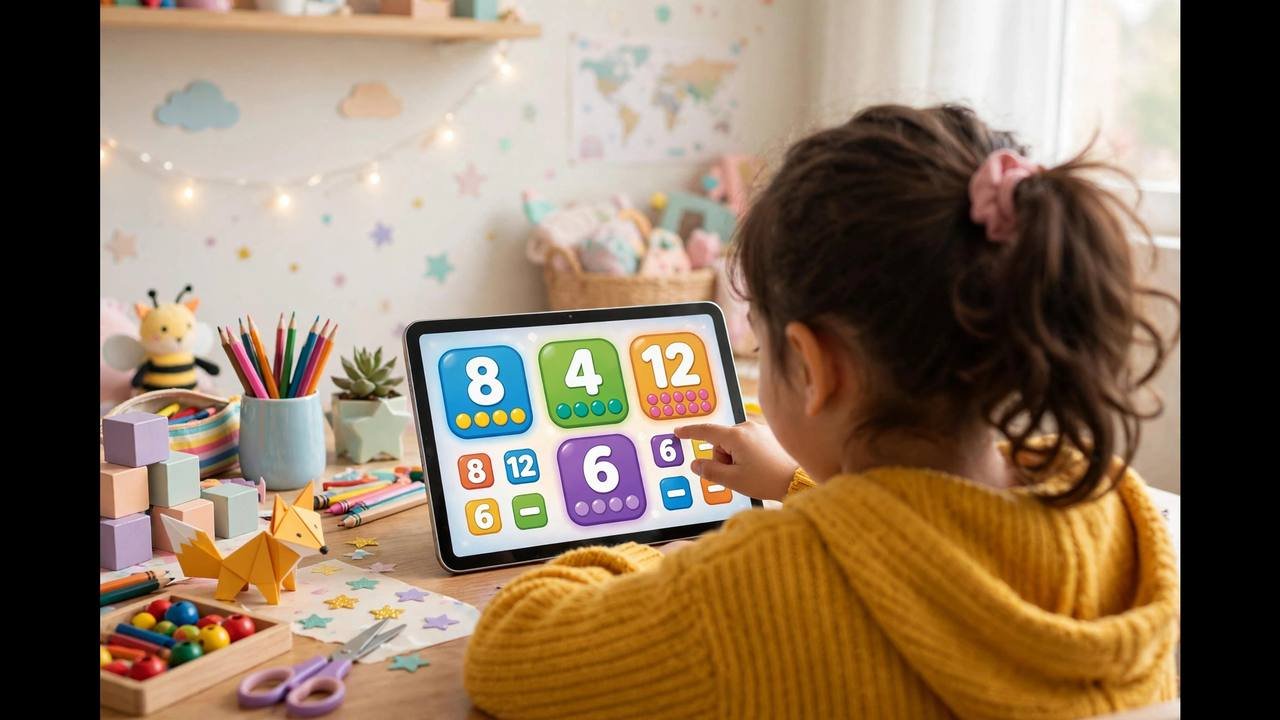
Maths is the subject parents feel least equipped to help with — and the one where the right online maths program makes the biggest difference. The Australian market is crowded: global giants, homegrown curriculum-aligned platforms, game-based apps and free video libraries all compete for your child’s attention. This guide compares the best online maths programs for Australian kids by age, learning style and price, so you can confidently pick the one your child will actually use — because the best maths program is the one that gets opened.
What makes a maths program good (the parent’s checklist)
- Australian Curriculum alignment: non-negotiable for core maths. The terminology, year-level progression and problem styles should match what Australian classrooms teach.
- Adaptive difficulty: the program should find your child’s level and adjust — too easy is boring, too hard is crushing. Placement tests and adaptive engines do this automatically.
- Conceptual understanding, not just drill: the best programs teach why (visual models, multiple representations), not just what (answer-getting). Rote drill has its place for fluency, but understanding is what transfers.
- Parent visibility: dashboards showing what was practised, where they’re struggling, and how they’re progressing. You’re the coach — you need the data.
- Engagement that lasts past week two: gamification, streaks, competitions — whatever works for your child. A brilliant program nobody opens teaches nothing.
The big names compared
Mathletics — the Australian institution
By 3P Learning, Mathletics is the maths platform most Australian parents already know — it’s in thousands of schools nationwide. Coverage runs Kindergarten to Year 12, fully mapped to the Australian Curriculum, with adaptive activities, the famous Live Mathletics mental-maths competitions (kids racing peers in real time), and detailed parent/teacher reporting.
- Strengths: comprehensive curriculum coverage, school integration (if the school uses it, home access multiplies the value), proven track record.
- Considerations: the interface feels dated to some kids; the drill-heavy style suits competitive learners more than exploratory ones. Family pricing varies — check current plans.
- Best for: families wanting thorough curriculum coverage; kids motivated by competition. Official site: mathletics.com.au.
Matific — the engaging challenger
The newer Australian-aligned platform winning over schools and families with genuinely beautiful, game-like interactive activities. Where Mathletics drills, Matific explores — visual models, inquiry-based problems, and a sense of play that holds attention.
- Strengths: exceptional engagement for primary ages, strong conceptual teaching, research-backed design.
- Considerations: primary-focused (Foundation–Year 6ish); older students will outgrow it.
- Best for: ages 5–11, especially kids who find traditional maths boring or anxiety-inducing.
Prodigy — the free game kids beg to play
A fantasy adventure game where maths questions power the magic. The free tier is substantial and curriculum-aligned; the adaptive engine keeps challenge in the sweet spot. Parent email updates show exactly what was practised.
- Strengths: free, genuinely fun, strong adaptivity. The rare program kids choose voluntarily.
- Considerations: the game wrapper means some kids focus on the game over the maths; paid extras are unnecessary for most families.
- Best for: reluctant mathematicians; supplementing a more structured program.
Khan Academy — the free tutor
The global free library: superb video explanations plus practice exercises from early primary through senior secondary. The maths explanations are among the clearest anywhere — when your child is stuck at 8pm, a 6-minute Khan video often succeeds where the textbook failed.
- Strengths: free forever, excellent for specific topic rescue, goes as far as senior secondary and beyond.
- Considerations: American origin (terminology mostly fine for maths); less gamified — suits motivated learners more than reluctant ones.
- Best for: homework rescue, extension, secondary students.
Eddie Woo / Wootube — the Australian teacher
Sydney teacher Eddie Woo’s free YouTube channel: Australian classroom-style maths explanations that students love because he teaches the way they’re taught at school. Not a “program” in the structured sense — it’s the best free supplement in the country for Years 5–12.
Mathseeds — for the little ones
From the Reading Eggs stable (Blake eLearning): ages 3–9, the same polished, adaptive, Australian-made approach applied to early numeracy. If your family already uses Reading Eggs, adding Mathseeds is natural — and the bundle pricing makes sense.
By age and need: which to pick
- Ages 3–6: Mathseeds for structured early numeracy; Prodigy’s early levels for play. Keep it light — 10 minutes, a few times a week.
- Ages 7–9: Matific for engagement + conceptual depth; Mathletics if the school uses it; Prodigy as the fun supplement. This is where times-tables fluency gets built — daily short practice beats weekly long sessions.
- Ages 10–12: Mathletics or Khan Academy for curriculum coverage; Matific while it lasts; start introducing problem-solving beyond the curriculum (Australian Maths Trust resources). NAPLAN numeracy preparation fits here — see our NAPLAN guide.
- Ages 13+: Khan Academy and Eddie Woo for topic mastery; school textbooks and teacher support for the rest. At this level, programs supplement rather than lead.
- Struggling learners: Matific’s visual approach and Prodigy’s low-pressure game format reduce maths anxiety. Crucially, let the adaptive placement put them at their actual level — a Year 5 child doing Year 3 maths successfully rebuilds confidence faster than failing at Year 5 content.
- Advanced learners: Khan Academy lets them race ahead unlimited; Beast Academy and Australian Maths Trust enrichment provide genuine challenge. Don’t hold a fast kid to year-level content — boredom is the enemy.
Fluency vs understanding: getting the balance right
Maths learning needs both: fluency (fast, accurate recall of facts and procedures) and understanding (knowing why procedures work and when to apply them). Programs lean different ways:
- Fluency builders: Mathletics Live, times-table apps, Prodigy’s repetition. Essential — a child who can’t recall 7×8 quickly drowns in later maths regardless of understanding.
- Understanding builders: Matific’s visual models, Khan Academy’s explanations, Eddie Woo’s derivations. Essential — procedures without understanding collapse at the first unfamiliar problem.
The ideal weekly mix for primary kids: 3–4 short fluency sessions plus 2–3 understanding-focused sessions. If you only pick one program, choose the understanding-builder and add free fluency practice (even chanting times tables in the car counts).
Making it stick: the parent playbook
- Same time daily: 15–20 minutes beats an hour on Sunday. Habit beats heroics.
- Talk about the maths: “how did you work that out?” — explaining cements learning far more than answering does.
- Connect to real life: cooking (fractions), shopping (percentages, budgeting), sport statistics, building projects (measurement). The transfer from screen to world is where maths becomes real.
- Normalise mistakes: wrong answers are data. If the program’s adaptivity is working, your child should be getting questions wrong regularly — that’s how it finds the learning edge.
- Watch the dashboard, not the clock: 15 focused minutes with improving accuracy beats 30 distracted minutes. Use parent reports to spot stuck points early.
- Don’t teach competing methods: if the school teaches one written method and you learned another, defer to the school’s method for homework — then discuss alternatives as enrichment, not correction.
For the broader home-learning system these sessions sit within, see our guide to supporting your child’s online learning at home and the learning platforms comparison.
Maths anxiety: helping worried kids
Maths anxiety is real, common, and — importantly — not a fixed trait. If your child says “I’m just bad at maths” or melts down over homework, the program choice matters enormously:
- Choose low-stakes environments first: Prodigy and Matific feel like games, not tests. Timed competitions (Mathletics Live) can worsen anxiety — turn them off initially.
- Shrink the steps: anxiety spikes when the gap between current ability and task feels huge. Adaptive placement at the right level, plus parent-set easier starting points, rebuilds the success cycle.
- Separate speed from ability: many anxious kids equate slow with stupid. Explicitly teach that mathematicians think slowly — speed is a fluency skill built over time, not a measure of intelligence.
- Watch your own maths story: “I was never good at maths either” feels sympathetic but teaches that maths ability is inherited and fixed. Try: “maths felt hard for me too, and I wish I’d had these tools.”
- Celebrate strategies, not answers: “I love how you tried three different approaches” builds the growth mindset that dissolves anxiety over time.
If anxiety is severe and persistent — avoidance, tears, physical symptoms — talk to the school. Sometimes the issue isn’t the maths at all but perfectionism or a past humiliation that needs addressing directly.
Competitions and enrichment: for kids who want more
Some kids don’t just tolerate maths — they love it. Australia has a rich enrichment ecosystem:
- Australian Maths Trust competitions: the AMC (Australian Mathematics Competition) runs annually in schools nationwide — accessible, fun, and a great first competition. The AMOC and olympiad programs follow for the truly keen.
- Maths games days and challenges: state associations run problem-solving days that feel more like puzzles than tests.
- Beast Academy: the books + online program for advanced primary kids — genuinely challenging, beautifully designed, and beloved by gifted learners.
- Extension within programs: Khan Academy’s advanced tracks and Mathletics’ higher-year content let fast kids self-extend without waiting for school.
The enrichment principle: depth over acceleration. A Year 5 child doing rich Year 5 problem-solving learns more than one rushed through Year 7 procedures. Competitions teach the most valuable lesson of all — that hard problems are enjoyable.
Free vs paid: the decision framework
You can cover maths completely free: Prodigy + Khan Academy + Eddie Woo costs $0 and handles most situations through secondary. So when does paid make sense?
- Pay when the school uses it: if the classroom runs Mathletics, home access to the same platform is the highest-value subscription available — alignment multiplies everything.
- Pay for engagement: if your child will happily do 20 minutes of Matific but won’t touch free alternatives, the subscription buys actual learning hours. Engagement is the scarcest resource.
- Pay for reporting: detailed parent dashboards save you the work of diagnosing gaps yourself. For time-poor parents, this alone can justify the cost.
- Don’t pay for: duplicate coverage (two full maths programs), features your child never uses, or annual plans before a proper trial.
Typical family maths spending: $0–$150/year. One well-chosen subscription plus free supplements beats a stack of subscriptions every time — and the money saved can go toward the experiences, books and activities that build the well-rounded kid behind the mathematician.
The secondary years: how needs change
Past Year 7, the game changes. Curriculum-specific programs matter less; topic mastery matters more:
- Khan Academy becomes the core tool: search the exact topic (“quadratic equations”), watch the explanation, do the practice. It’s the closest thing to a personal tutor available free.
- Eddie Woo for the Australian classroom: when the textbook explanation doesn’t land, his classroom-style videos usually do — same curriculum, same language, different voice.
- Past papers for exam years: Years 10–12 maths is substantially about exam technique. School-provided past papers plus worked solutions beat any program.
- The tutor threshold: secondary maths gaps compound fast — missing algebra foundations in Year 8 makes Year 10 miserable. If your teen is lost, a few targeted tutoring sessions to rebuild foundations pay off more than months of program practice on shaky ground.
- Calculator competence: know what the school expects — CAS calculators in senior years are powerful tools that need learning in their own right.
When a program isn’t enough
Maths programs are brilliant for practice and reinforcement, but they can’t diagnose why a child is stuck. Step up when:
- Your child is 12+ months behind despite consistent program use — talk to the teacher about assessment for dyscalculia or gaps.
- Maths causes genuine distress — anxiety needs addressing directly, not just more practice. A tutor who rebuilds confidence 1-on-1 often succeeds where programs failed.
- They’ve plateaued for a term — the program may have taken them as far as it can; a human needs to find the specific misconception. A fresh pair of eyes often spots in one session what months of adaptive algorithms missed.
- They’re racing ahead and bored — seek extension (Maths Trust, competitions, advanced Khan tracks) rather than just accelerating through the same program.