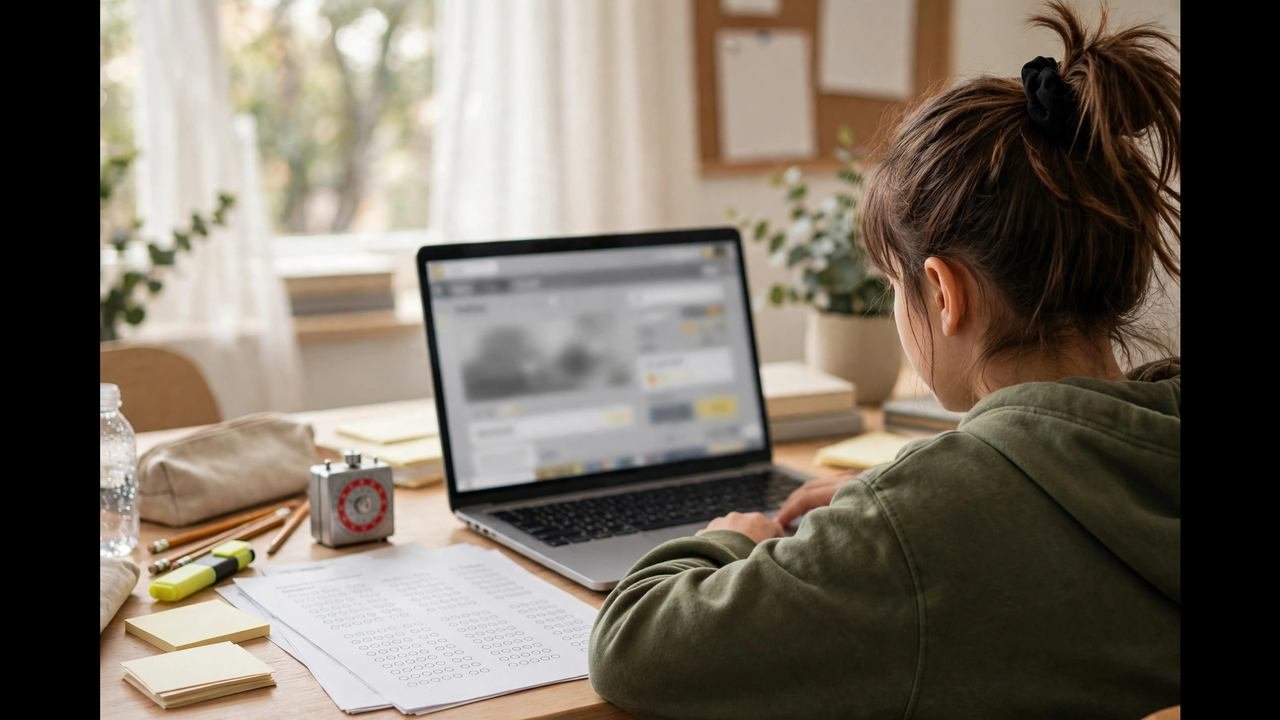
Every year, tens of thousands of Australian families take on the selective school test — one of the most competitive exams a primary or early secondary student will ever sit. Good selective school test preparation isn’t about hot-housing your child or drilling past papers until they burn out. It’s about building genuine skills over time: reading widely, reasoning clearly, and writing confidently under pressure. And the good news is that much of this preparation can now be done online, from home, at your family’s pace.
In this guide, we’ll break down how selective tests work in NSW, Victoria, Queensland and WA, lay out a sensible 12-month preparation plan, and show you how to use online resources effectively — without turning your home into a pressure cooker.
What Are Selective School Tests?
Selective schools are government schools that admit students on academic merit rather than catchment. They teach the standard curriculum at a faster pace and greater depth, surrounded by high-achieving peers — and because there are no fees, competition for places is fierce. In NSW, roughly 15,000 students apply each year for around 4,200 Year 7 places.
Each state runs its own test, and the formats differ significantly. But they share a philosophy: these are ability tests, not curriculum exams. They measure reading comprehension, mathematical reasoning, critical thinking and written expression — skills that develop over months and years, not weeks of cramming. That’s why steady, well-planned selective school test preparation beats last-minute drilling every time.
NSW: The Selective High School Placement Test
NSW has the largest selective system in Australia, and its test changed significantly in recent years. Here’s the current format, based on the NSW Department of Education’s published materials:
- Reading — 45 minutes, 17 multiple-choice questions (some multi-part, giving 38 answers in total). Tests inference, vocabulary in context and author’s purpose.
- Mathematical Reasoning — 40 minutes, 35 multiple-choice questions covering whole numbers, fractions, ratios, percentages, geometry and multi-step word problems.
- Thinking Skills — 40 minutes, 40 multiple-choice questions on critical thinking and problem-solving. No curriculum knowledge required.
- Writing — 30 minutes, one typed extended response to a stimulus. Marked by two examiners.
Each component carries equal weight — 25 per cent of the total score. That surprises many families: writing counts exactly as much as maths. The test is fully computer-based, sat at a designated test centre (usually a local high school) in early May of Year 6. Applications open in early November of Year 5 and close in February of Year 6. There is no negative marking, so students should attempt every question, and calculators are not permitted in any section.
Two things catch parents out. First, the writing task must be typed — children who hunt-and-peck lose precious composing time, so typing fluency (around 30–35 words per minute) is a genuine part of preparation. Second, NSW now uses an Equity Placement Model reserving up to 20 per cent of places for students from disadvantaged backgrounds, rural areas or with disability, and co-ed schools aim for gender balance — which makes general-entry cut-offs increasingly competitive.
Victoria, Queensland and WA: How Other States Test
Victoria takes a different path. Its four Selective Entry High Schools (Melbourne High, Mac.Robertson Girls’, Nossal and Suzanne Cory) admit at Year 9, not Year 7. Students sit a single ACER-administered exam in June of Year 8: three paper-based blocks covering Mathematics plus Quantitative Reasoning (60 minutes), Reading plus Verbal Reasoning (55 minutes), and Writing (40 minutes, two tasks). There are around 1,000 Year 9 places each year, an application fee applies, and calculators are banned. Don’t confuse this with SEAL programs — accelerated classes inside regular schools that run their own separate entrance tests in Year 6.
Queensland has two main pathways. Brisbane State High School uses ACER’s HAST (Higher Ability Selection Test) — a paper-based test of reading comprehension, mathematical reasoning and written expression. The three Queensland Academies (science/technology, creative industries, health sciences) use an EduTest-style computer-based assessment covering verbal reasoning, numerical reasoning, reading comprehension and mathematics, plus a written expression task for Year 7 entry. Selection also weighs school reports and interviews, not just the test.
Western Australia’s Perth Modern School — the state’s only fully selective school — admits through the Academic Selective Entrance Test (ASET) as part of the GATE program, alongside gifted programs at schools like Willetton and Shenton College.
The takeaway: always prepare for your state’s test. A NSW-focused question bank won’t help a child sitting Victoria’s paper-based ACER exam, and vice versa. Check your education department’s website for the current format before you begin.
Selective School Test Preparation: A Sensible 12-Month Plan
The most effective selective school test preparation follows a simple rhythm: diagnose, build skills steadily, then practise under timed conditions. Rushing straight to mock tests is the most common mistake families make — stamina and strategy mean little without the underlying skills. Here’s how a 12-month plan typically unfolds for a Year 5 student targeting the NSW test (adjust the timeline to your state’s test date).
Months 12–9: Foundations
Start with a diagnostic — a practice test or assessment that reveals your child’s strengths and gaps across the four components. Then build the base: daily wide reading (fiction and non-fiction), regular maths problem-solving beyond the school curriculum, and short typing practice sessions a few times a week. Keep it light — this phase is about habits, not hours.
Months 9–6: Skill building
Now target the weak spots the diagnostic revealed. If thinking skills are the gap, work through reasoning question types systematically. If writing is the weakness, practise structured 30-minute responses with planning, drafting and editing. Introduce one timed section per week so the clock becomes familiar, not frightening.
Months 6–3: Timed practice
Shift toward full timed sections and then complete mock tests under exam conditions — same timing, no interruptions, computer-based for NSW. Review every error carefully: the mistake analysis matters more than the score. Keep total preparation around five to six hours per week including any tutoring; if sleep, mood or family time is suffering, you’ve gone too far.
Final weeks: Taper
Ease off. Light revision, one final mock, then rest. A well-rested child with solid skills will outperform an exhausted child with a few extra practice papers every time. The night before the test: early bed, normal dinner, laid-out clothes. Test morning: a proper breakfast and a calm, unhurried start.
One principle runs through the whole year: don’t sacrifice school for test prep. Brisbane State High School’s own published advice puts it well — the best preparation is being actively engaged in current learning at primary school. If preparation is damaging schoolwork, friendships or wellbeing, pull back. Our guide to creating a learning routine for kids at home shows how to fit preparation into a balanced week.
How to Prepare for Each Section
Reading
There’s no shortcut here: children who read widely, read well. Encourage daily reading across genres — novels, news articles, opinion pieces, science writing. Practise the specific skills the test targets: finding the main idea, inferring meaning, understanding vocabulary in context, and identifying the author’s purpose. For NSW’s computer-based test, practise reading longer passages on screen; digital reading stamina is a real and trainable skill.
Mathematical Reasoning
This section rewards flexible problem-solving, not memorised formulas. Work through multi-step word problems, puzzles involving fractions, ratios and percentages, and data interpretation (tables, graphs). Teach your child to show working on scrap paper, eliminate obviously wrong options, and move on from stuck questions — with no negative marking, every attempted question is a free chance at points.
Thinking Skills
This is the section with no school equivalent, so it deserves dedicated attention. Practise the common question families: verbal analogies, logical puzzles, pattern and sequence completion, and argument analysis (identifying assumptions, conclusions and flaws). Because the NSW Department doesn’t publish its internal reasoning taxonomy, work from official practice materials and reputable question banks rather than memorising any single list of “types”.
Writing
With writing worth a full quarter of the NSW score, it deserves a quarter of the effort. Practise all likely genres — narrative, persuasive and discursive — against the clock: five minutes planning, twenty writing, five editing. Build typing fluency early so mechanics don’t eat composing time. And read strong writing aloud together; children absorb structure, vocabulary and rhythm from what they hear and read.
Selective School Test Preparation Online: Making It Work
Online preparation suits selective tests particularly well — especially in NSW, where the test itself is computer-based. Practising on screen builds the exact skills exam day demands: reading long passages on a monitor, managing time with an on-screen clock, and typing a full writing response under pressure. A child who has only ever done paper practice can find the digital interface surprisingly draining.
That said, online study needs structure to work. Set up a dedicated, distraction-free spot and use a timer for every practice section — untimed “practice” teaches content but not exam craft. Mix formats deliberately: on-screen timed sections for realism, plus paper working for maths reasoning (just as they’ll get scrap paper at the test centre). And keep one rule sacred: preparation happens at the desk, not on the couch with a phone in reach. The environment you practise in becomes the focus you bring to the test.
For families in regional and remote areas, online preparation is often the only practical option — and it’s a genuine leveller. A student in Broken Hill can now access the same quality of practice materials and tutoring as a student in Sydney’s east, which simply wasn’t true a decade ago. If you’re considering a tutor for selective preparation, our guide to online vs in-person tutoring breaks down which format suits different learners.
Free and Low-Cost Online Resources
You don’t need to spend thousands on preparation. Start with what’s free:
- Official practice tests. The NSW Department of Education publishes free practice tests showing the real format and question styles — these are the single most valuable resource for NSW families. Victoria’s ACER and Queensland schools similarly publish sample materials.
- The department’s own guidance. The NSW Department of Education parent guide to selective high schools and opportunity classes explains the application process, key dates and placement rules straight from the source.
- Typing tutors. Free online typing programs build the speed NSW candidates need for the typed writing task. Ten minutes a day from Year 5 compounds remarkably.
- Library resources. Your local library’s free e-book apps, puzzle books and past-paper collections cost nothing.
If you do pay for help, choose carefully: look for providers who teach skills rather than just drilling papers, who know your state’s current format, and who publish realistic weekly time commitments. Online tutoring works particularly well for selective preparation since so much of the test itself is now computer-based — weigh the formats against your child’s learning style before committing.
Exam Day: Keeping It Together
After a year of preparation, exam day should feel like a normal morning. A few practical points: confirm the test centre location and arrival time the night before, and do a trial run of the journey if it’s unfamiliar. Pack water, a snack for breaks, and any permitted materials — then double-check the prohibited list (no calculators, no dictionaries, no smartwatches for most sittings). Dress in comfortable layers; test halls run hot and cold.
Most importantly, manage the emotional temperature. Your child will take their cues from you. Keep the morning low-key, avoid last-minute cramming or strategy lectures in the car, and have a simple plan for afterwards — something enjoyable and unrelated to the test. If your child tends toward anxiety, a calm, predictable morning routine helps enormously; our article on school refusal and what parents can do covers morning-routine strategies that work just as well for exam-day nerves.
Whatever happens, frame the outcome honestly: selective entry is brutally competitive, not getting a place says nothing about your child’s ability, and there are many excellent pathways through non-selective schools. Children who feel their worth isn’t riding on one morning perform better on that morning anyway.