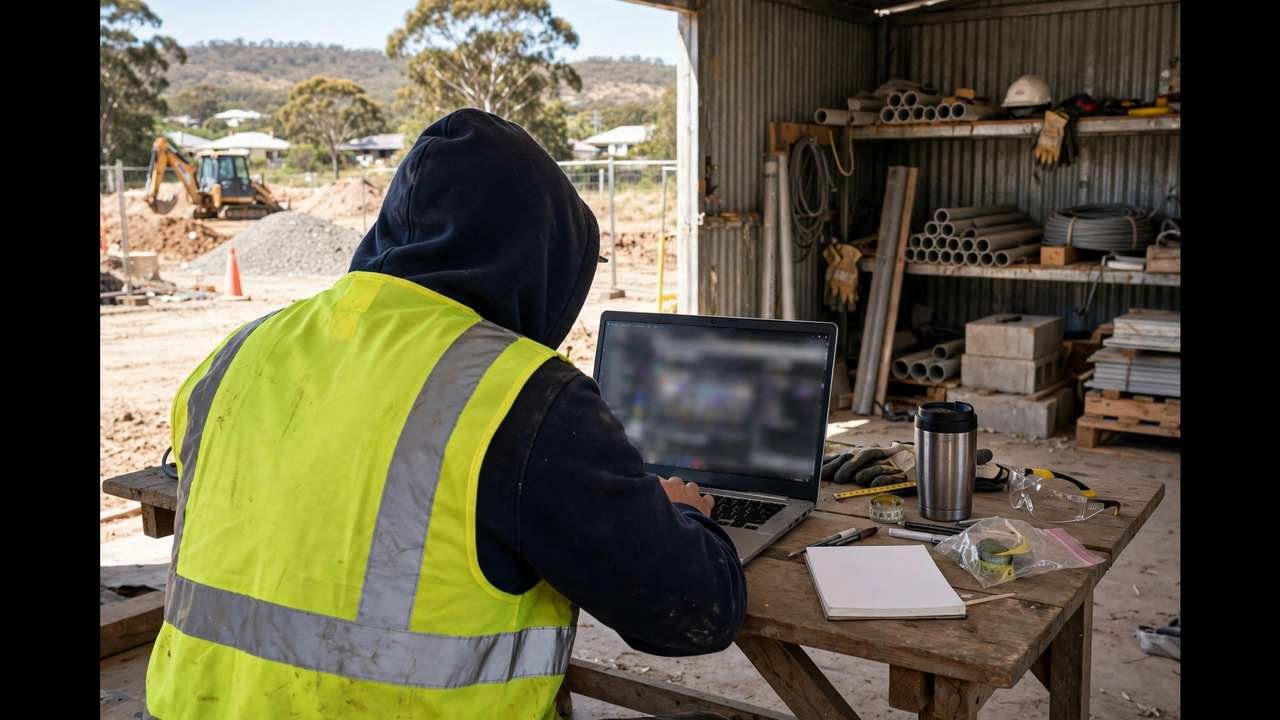
It sounds like a punchline — sparky to software developer — but the tradie to tech pipeline is one of the most successful career-change stories in Australia. Electricians, plumbers, carpenters and mechanics are moving into software development, data analysis, cyber security and cloud engineering in growing numbers, and they’re succeeding at rates that surprise everyone except the people who’ve watched them work. This guide explains why tradies are quietly built for tech, which pathways actually work, what it costs, and how long it takes.
Take Matt, a former electrical tradesman from regional Queensland who retrained through a Bachelor of Information Technology at QUT, won a HUB24 Technology Scholarship during his studies, and walked into a graduate software developer role at HUB24. His story — documented by QUT — isn’t exceptional because he’s unusually gifted. It’s exceptional because he followed a path that’s available to any tradie willing to do the work.
Why tradies are built for tech (seriously)
The overlap between trade work and technology work is deeper than it looks from the outside. Consider what a good tradie does every day:
- Systematic troubleshooting: an electrician fault-finding a dead circuit follows the same diagnostic logic as a developer debugging code — isolate variables, test hypotheses, narrow down. Tradies do this physically, all day, under time pressure.
- Reading complex systems: wiring diagrams, hydraulic schematics, building plans. Code is just another schematic — arguably a simpler one, since you can’t get electrocuted by a misplaced semicolon.
- Working to specification: trades run on standards, codes and tolerances. Software runs on specifications, tests and code review. The mindset transfers directly.
- Physical stamina and work ethic: anyone who’s done a 12-hour day on a roof in January has the grit for a hard study program. Tech’s “grind culture” is a pale imitation of actual physical labour.
- Client and site communication: explaining to a homeowner why the job costs what it costs is stakeholder management. Tradies who’ve run their own business already understand quoting, clients and cash flow — directly relevant to freelancing or contracting in tech.
There’s even a growing argument in Australian tech circles that software engineering should be thought of as a skilled trade — learned through practice, apprenticeship and doing, not just theory. The average coding bootcamp student is 31 years old; the tradie-to-tech path fits that profile perfectly.
The honest comparison: trade pay vs tech pay
Let’s talk money plainly, because this is the calculation every tradie makes. Market data puts electricians at roughly $44,900–$96,700 nationally (average around $62,400), plumbers $43,200–$93,000 — with experienced tradies, especially those running their own business or working FIFO/mining, earning well above those averages. Nobody should pretend the starting tech salary beats a good tradie’s income.
Entry-level tech roles pay $65,000–$80,000. So in year one, you may well take a pay cut — that’s the honest part. But the trajectory differs sharply:
- Software engineer: ~$106,800 average nationally; senior engineers $140,000–$165,000+
- Data analyst: $95,000–$120,000 (average ~$107,500)
- Cyber security analyst: $115,000–$140,000 at mid-level
The real financial case for tradie-to-tech isn’t the starting salary — it’s the ceiling and the body. Tech salaries keep climbing with experience without requiring you to start a business or destroy your knees. And the work doesn’t get physically harder as you age; it gets more valuable. For tradies in their 30s and 40s thinking about what their body will tolerate at 55, that’s the calculation that matters.
There’s also the flexibility dividend: remote work, flexible hours, no commute to sites. Parents coming off FIFO rosters or 6-day site weeks consistently cite this as the life-changing part, ahead of the money.
Which tech lane fits which trade?
Different trades map naturally to different tech specialisations:
- Electricians → software development, embedded systems, IoT. The strongest natural fit. Electrical theory maps to computing fundamentals, and embedded/IoT work literally combines both worlds. Matt’s path — electrician to software developer — is the template.
- Mechanics / diesel fitters → data, automation, robotics. Diagnostic thinking plus mechanical systems knowledge suits industrial data roles, automation and robotics — huge in mining and manufacturing.
- Plumbers / HVAC → cloud infrastructure, DevOps. It sounds odd until you hear it framed right: plumbers make water flow; DevOps engineers make data flow. Systems thinking about pressure, capacity and failure points transfers remarkably well to infrastructure work.
- Carpenters / builders → web development, UX. Builders think in structures and user experience (how people move through a space). Frontend development rewards the same spatial and design instincts.
- Any trade → cyber security, IT support. Security values practical, adversarial thinking — how would you break into this? Tradies who’ve spent careers finding physical vulnerabilities adapt fast to finding digital ones.
These aren’t rigid rules — any tradie can learn any lane — but starting where your instincts already point shortens the learning curve considerably.
Pathways that work for tradies
1. TAFE ICT qualifications. The Certificate IV and Diploma of Information Technology are the natural VET pathway: 6–18 months, $2,000–$15,000 with state subsidies available, nationally recognised. The structured classroom environment suits people used to hands-on learning, and TAFE teachers are accustomed to mature-age students.
2. University degrees (part-time/online). Matt’s QUT Bachelor of IT path is the gold standard for depth. A computing degree takes 3 years full-time (longer part-time), costs more, but opens every door including the most competitive graduate programs. HECS-HELP defers the cost. If you’re under 35 and can commit, this is the highest-ceiling option.
3. Bootcamps. 8–24 weeks intensive, $3,000–$17,500. The time efficiency appeals to tradies who can’t afford years out of earning — but vet outcomes ruthlessly and talk to graduates. The best bootcamps for career changers publish real employment data.
4. Funded pathway programs. _nology’s fully funded 8–12 week program (with 18-month paid placements) and AWS re/Start specifically target career changers — 87% of _nology’s cohort come from non-tech backgrounds. Free, competitive, and designed for people exactly like you.
5. Self-study while still on the tools. Many tradies start with free resources (freeCodeCamp, CS50) during evenings, build foundational skills over 6–12 months without quitting, then commit to a formal program. This de-risks the whole transition: you find out whether you actually enjoy coding before spending a dollar or quitting a job.
The financial plan: managing the transition
The pay-cut year is the part that stops most tradies — so plan for it explicitly:
- Don’t quit on day one. Study part-time while working for the first 6–12 months. Evening and weekend study around site work is exhausting but financially safe.
- Build a 6-month buffer. Before quitting to study full-time or take a junior role, save enough to cover the gap between your tradie income and your first tech salary.
- Consider the bridge: some tradies transition via tech-adjacent roles first — working for a construction tech company, doing IT support for a trades business, or freelance web work for tradie mates. Earning while building relevant experience.
- Use every subsidy: Fee-Free TAFE, state skills programs, and employer incentives for ICT traineeships (adult trainees commonly earn $850+/week) all reduce the cost. Our government-funded training guide lists what’s available in your state.
- Talk to your accountant: self-education expenses for career-change study have specific tax treatment in Australia — get advice before you assume deductibility.
What the first year in tech feels like for a tradie
Tradies who’ve made the jump report a consistent pattern. The first 3 months are humbling — you’re suddenly the least experienced person in the room, and the work is entirely mental after years of physical competence. Imposter syndrome is intense.
Around month 4–6, something clicks: the systematic thinking from trade work starts compounding with technical knowledge, and progress accelerates. Tradies consistently report that debugging, in particular, feels like fault-finding on a circuit — familiar territory in unfamiliar clothes.
By month 12, the tradie background becomes an asset rather than a gap. You communicate clearly with non-technical stakeholders (years of explaining jobs to clients), you don’t panic under pressure (deadlines are nothing after concrete pours), and you bring a practical bias — ship it, fix it, move on — that pure-academic juniors often lack. Hiring managers notice.
The cultural adjustment is real, though. Tech workplaces communicate differently — more written, more async, more meetings about meetings. And you’ll need to get comfortable with the reality that your physical skills, the thing you’ve been valued for, don’t transfer. What transfers is everything around the physical skills: the judgement, the discipline, the problem-solving.
Common objections — answered honestly
“I’m too old to start over.” The data disagrees. The average coding bootcamp student is 31; funded career-changer programs specifically recruit people with years of professional experience. Tech employers increasingly value maturity — reliability, communication and judgement are in short supply among junior hires. Your 15 years on the tools isn’t starting over; it’s arriving with assets.
“I’m not good at maths.” Most software development uses far less maths than people fear — logic and systematic thinking matter more than calculus. (Machine learning and data science are the exceptions; they need real statistics.) Electricians already do more applied maths daily than most developers.
“I’ll have to take a massive pay cut.” Possibly in year one — plan for it with savings and part-time study rather than a cliff-edge resignation. But compare 10-year trajectories, not starting salaries. And factor in the physical cost: what does another decade of trade work do to your body versus a decade at a desk?
“Tech is laying people off.” Big-tech layoffs make headlines, but Australian tech employment overall keeps growing — particularly in cyber security, data, AI and government digital. Junior hiring is cyclical; skills are permanent. Time your entry sensibly, but don’t let headlines decide your decade.
“What if I hate sitting at a desk?” Valid concern. Try before you commit: the 5-hour test in the action plan above exists precisely for this. Some tradies discover they love deep focused work; others realise they need physicality and pivot to field-adjacent tech roles (IoT installation, tech sales, solutions engineering) that keep them moving.
Keep your ticket: the safety net strategy
Here’s advice you won’t get from bootcamp salespeople: don’t burn your trade qualification. Keep your licence current and your ticket valid through the transition. The reasons are practical, not sentimental:
- Financial safety net: if the tech job market softens or your first role doesn’t work out, weekend trade work pays better than any stopgap job.
- Negotiating power: knowing you can always go back to well-paid trade work means you don’t accept exploitative junior offers out of desperation.
- Hybrid opportunities: the most interesting roles for ex-tradies sit at the intersection — construction tech, proptech, industrial IoT, mining technology. Companies building software for trades desperately need people who understand both worlds, and they pay premiums for it.
- Optionality: some tradies end up running tech-enabled trade businesses — using software skills to systematise and scale what they already know. That’s not leaving the trade; it’s levelling it up.
The tradie-to-tech story isn’t about escaping the trades. It’s about adding a second powerful skill set to the formidable one you already have. The combination — someone who can wire a building and architect the software that runs it — is rarer and more valuable than either alone.
Your action plan
This month: pick a lane (use the trade-mapping above), and spend 5 hours on a free introductory resource — CS50, freeCodeCamp, or a Python tutorial. You’re testing for enjoyment, not aptitude. If you find yourself losing track of time, that’s your signal.
Months 2–6: study 8–10 hours a week around work. Build small projects. Join an Australian tech community (meetups, online groups) and start talking to people who’ve made the same jump.
Months 6–12: commit to a formal pathway — TAFE diploma, bootcamp application, or funded program. Build 2–3 substantial portfolio projects, ideally connected to the trades (a quoting app, a job-management tool, an electrical calculator).
Months 12–18: apply for junior roles. Target employers who value diverse backgrounds: government digital programs, mid-size SaaS companies, and any organisation running alternative-pathway intakes. Tell your story plainly — tradie to tech is a narrative hiring managers remember.
For the broader playbook that applies regardless of your starting trade, read our guide to getting into tech from a non-tech background — and if AI is where your interest lies, our AI courses roundup covers the fastest-growing corner of the industry.